
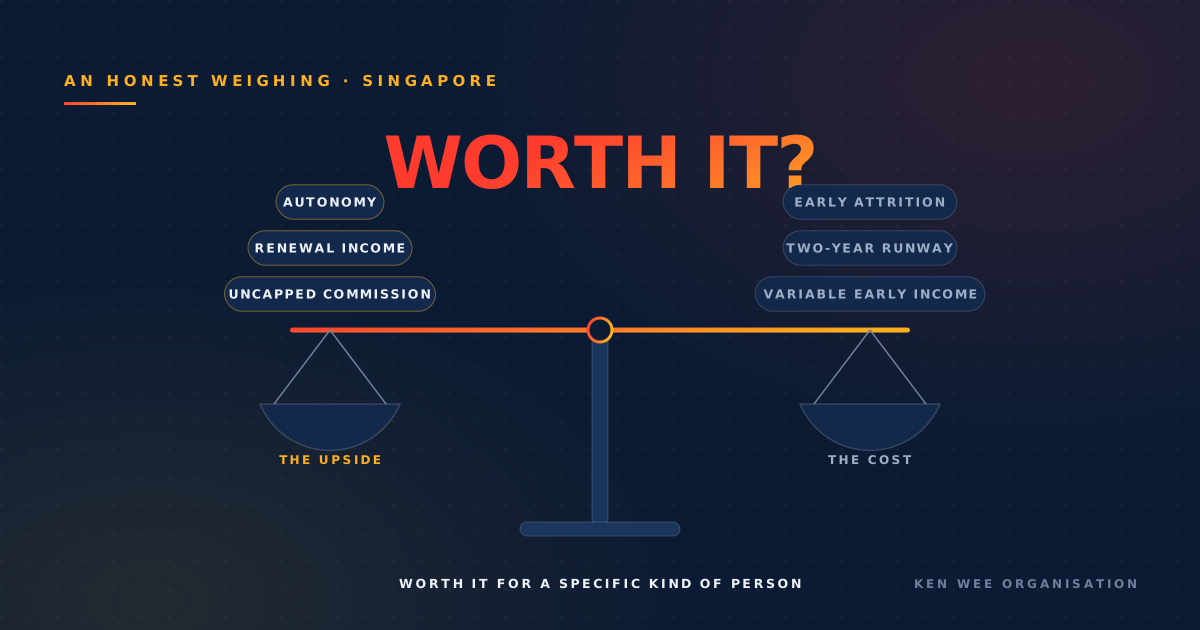
Being a financial advisor in Singapore is worth it for a specific kind of person: someone with the savings to survive a genuinely difficult first two years of low, variable income, and a real interest in the technical work of financial planning — CPF, tax, insurance structures, investment products. For that person, the career offers uncapped commission-based earnings, autonomy over their time, renewal income that compounds as a client base grows, and one of the lowest formal entry barriers of any earning path in Singapore: age 21, a polytechnic diploma or A-Levels (no degree required), and passes in the CMFAS examinations. For everyone else — anyone without a financial runway, or drawn mainly by the idea of easy money — it is usually not worth it, and the industry's early-years attrition reflects that. The deciding factor is not sales ability.
What "worth it" actually depends on
The question cannot be answered with a salary figure, because for most advisers there isn't one — most new advisers in Singapore operate as self-employed appointed representatives of a licensed or exempt financial adviser under the Financial Advisers Act 2001, remunerated by commission rather than salary. Whether the career pays off depends on three honest questions:
- Can you survive financially on a variable income for a sustained period? This is arithmetic, not willpower. If the answer is no, the career is wrong for you right now — build the runway first.
- Are you genuinely interested in the technical content? CPF rules, tax treatment, insurance and investment structures are the job, not the paperwork around it. Advisers who find the material interesting become good and stay; advisers who find it dull default to selling, which works briefly and then does not.
- Can you ask people for time, repeatedly, and metabolise rejection? Activity — qualified conversations — is the dominant variable in the early years, and it is almost entirely within your control.
Answer yes to all three and this is a career with real long-term economics and professional substance. Answer no to any one of them and you should think harder before resigning from anything.
The money: what can honestly be said
There is no reliable published figure for what a self-employed financial advisor in Singapore earns. Official wage statistics exclude this population by design: the Ministry of Manpower's occupational wage survey counts only financial services sales staff on a financial institution's payroll, and its own guidance tells firms not to report agency advisers who are not employees. What the official June 2024 data does show, for payroll-employed staff only:
| Occupation (payroll employees only) | Median gross monthly wage |
|---|---|
| Insurance sales agent/broker (incl. independent financial planner) | S$5,780 |
| Financial/investment adviser (e.g. relationship manager) | S$8,000 |
Those figures are neither a floor nor a ceiling for a commission-remunerated agency adviser — they describe a different population. What matters more for the "worth it" question is the structure of agency remuneration:
- First-year commission — a percentage of the first year's premium on newly implemented policies; the largest component early on.
- Renewal or servicing commission — smaller percentages paid for as long as the policy stays in force and you service the client. This is what turns the job into a business with recurring income.
- Overriding commission — for those who progress into leadership and are responsible for a team's production.
- Production bonuses and incentives — firm-specific and not guaranteed.
The honest shape of the income curve is low and volatile at the start, and increasingly stable as a client base accumulates. Work done in year one continues to pay in year six — provided the business stays on the books, which is where ethics and economics point the same way: policies sold to people who did not need them lapse, costing the client money and the adviser their renewal income.
What it costs to find out
One reason the career is worth seriously considering is that finding out is cheap and fast relative to almost any other regulated profession. The entry requirements under MAS Notice FAA-N26 (in force since 1 April 2024) are:
| Requirement | What it means |
|---|---|
| Minimum age | 21 years old |
| Academic qualification | A-Levels, IB Diploma, Singapore polytechnic diploma, or assessed equivalent — a degree is not required |
| Examinations (life-insurance-led practice) | RES5, plus M9 and M9A or the combined CM-LIP; plus HI for policies with accident and health benefits |
| Appointment | A principal firm certifies you as fit and proper and notifies MAS; your name enters the public register |
Exam fees run to a few hundred dollars in total (RES5 is S$150–180 plus GST; CM-LIP S$200–240 plus GST, per the Singapore College of Insurance's published schedule), there is no limit on resits, and the elapsed time from decision to first client conversation is commonly a few months. Note that RES5 carries the higher pass marks — at least 75% for Part I and 80% for Part II — so it deserves more preparation than the product paper, not less. The full pathway, exam by exam, is covered in our complete guide to becoming a financial advisor in Singapore.
The trade-offs, side by side
| Worth it: the genuine advantages | Not worth it: the genuine costs |
|---|---|
| Income is not capped by a salary band — remuneration tracks the practice you build | The first two years are financially hard; this is the single biggest reason people leave |
| Real autonomy over your schedule, client focus and how you build your practice | Self-employed status: only MediSave CPF contributions are compulsory (above S$6,000 net trade income); Ordinary and Special Account contributions become voluntary |
| Renewal income compounds — a practice, not a job | No employer benefits: no paid leave, no employer medical cover, no guaranteed income during illness |
| Low formal entry barriers, high ceiling; open to career-switchers without finance backgrounds | A demanding compliance and continuing-education load — around 30 CPD hours a year (6 core + 24 supplementary) after your exempt first calendar year |
| Work with real consequence — cover you arranged standing between a family and financial crisis | A reputational headwind created by poor practitioners, which you inherit on day one |
The self-employed mechanics deserve emphasis because they surprise people leaving salaried jobs. IRAS classifies commission agents such as insurance agents as self-employed persons: you file as a business, you may deduct allowable business expenses (or use the 25% fixed expense deduction ratio if your gross income is S$50,000 or below), and nothing accumulates in your CPF Ordinary Account unless you deliberately contribute. If you are planning to buy property, that is a material change that needs planning, not discovering.
Is there a future in it?
The profession is substantial and stable: the Life Insurance Association reported 12,281 representatives holding exclusive tied-agency contracts as of 30 September 2025. Progression runs along two tracks — deepening your own practice, or building and leading a team. At HSBC Life (Singapore), the title ladder runs Wealth Solutions Consultant → Wealth Solutions Development Manager → Wealth Solutions Manager → Wealth Solutions Director, with overriding commission entering the picture at the management levels. Neither track is superior; some excellent advisers never take the management route, and a well-run agency does not treat that as failure.
How to decide properly
Do not decide from articles, including this one. Calculate your runway honestly, speak to at least three practising advisers — including at least one who left, usually the more informative conversation — and get any prospective firm's commission schedule and support terms in writing before you commit.
Ken Wee Organisation (KWO) is an agency unit representing HSBC Life (Singapore) Pte. Ltd. (Reg. No. 199903512M), established in February 2020. We recruit and develop Wealth Solutions Consultants, our Financial Adviser Representatives are licensed and regulated by the Monetary Authority of Singapore under the Financial Advisers Act, and our position on this decision is on record: we would rather have an honest conversation that ends in you deciding this career is not for you than recruit someone who leaves in eight months. If you want that conversation — including the parts of the career that are hard — book a career chat with our team, led by founder Phua Ken Wee and Rowena Wong.
Frequently asked questions
Is being a financial advisor worth it in Singapore?
It is worth it for people who can tolerate low, variable income in the first two years and are genuinely interested in the technical work of financial planning. The career offers uncapped commission-based income, autonomy, and renewal income that compounds as a client base grows, with low entry barriers (age 21, polytechnic diploma or A-Levels, CMFAS exam passes — no degree required). It is a poor fit for anyone without a financial runway, because most advisers are self-employed and early income is volatile.
How much do financial advisors earn in Singapore?
There is no reliable published figure for self-employed advisers, because MOM's official wage survey excludes agency advisers who are not payroll employees. For payroll-employed staff, MOM's June 2024 data records a median gross monthly wage of S$5,780 for insurance sales agents/brokers and S$8,000 for financial/investment advisers — figures that are neither a floor nor a ceiling for commission-remunerated agency advisers. Agency income is built from first-year commission, renewal commission, overriding commission for leaders, and production bonuses, and is typically low at the start and increasingly stable as a client base accumulates.
Is it hard to become a financial advisor in Singapore?
The formal barriers are low: you must be at least 21, hold A-Levels, an IB Diploma, a Singapore polytechnic diploma or an assessed equivalent, and pass the CMFAS examinations — RES5 plus M9 and M9A (or the combined CM-LIP), plus HI for policies with accident and health benefits. A firm then appoints you and notifies MAS. The process commonly takes a few months. The hard part is not entry — it is building a client base and surviving financially in the first two years.
Do financial advisors in Singapore get CPF contributions?
Self-employed advisers receive no employer CPF contributions. Only MediSave contributions are compulsory, and only where net trade income exceeds S$6,000; Ordinary Account and Special Account contributions are voluntary. Anyone leaving salaried employment — especially with property plans that rely on Ordinary Account balances — needs a deliberate voluntary contribution strategy.
Should I quit my job to become a financial advisor in Singapore?
Not before you have calculated an honest financial runway covering your fixed living costs without commission income, spoken to at least three practising advisers (including one who left the profession), and obtained your prospective firm's commission schedule and new-adviser support terms in writing. The exams and appointment take a few months, so the pathway itself is fast — the risk is entering without a runway, which is the main driver of early attrition.