
The short answer
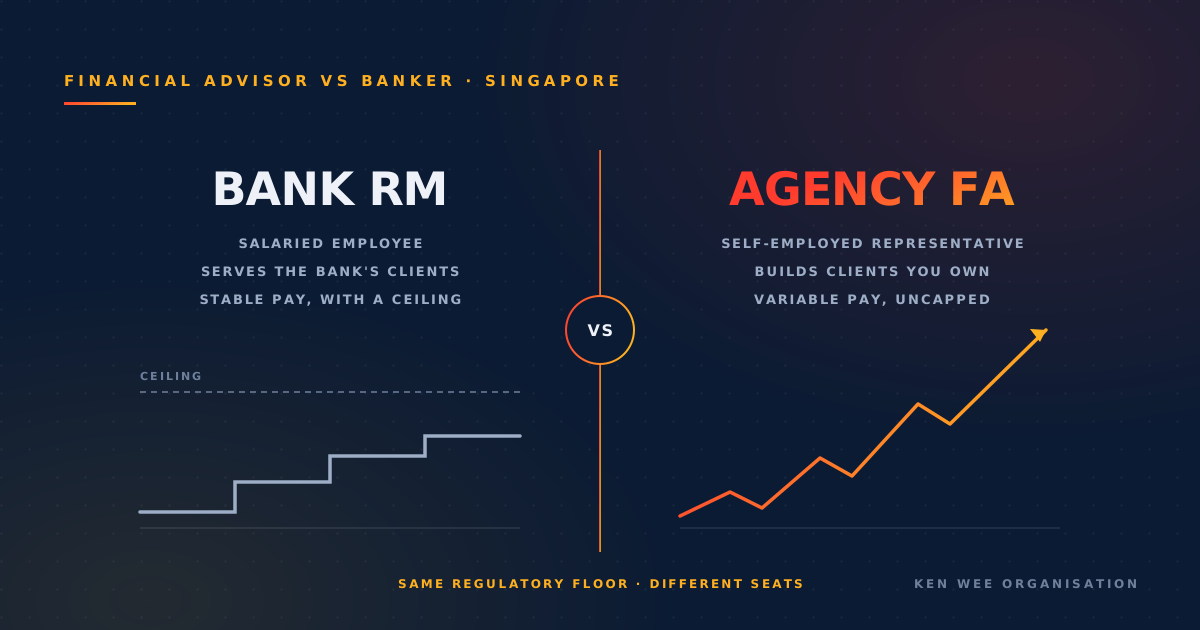
The core difference between a financial advisor and a banker in Singapore is not the products — it is the employment model and who owns the client relationship. A bank relationship manager is typically a salaried employee serving clients the bank already has, with income stability, employer CPF contributions, and a ceiling shaped by the bank's structure. A financial advisor at an agency or advisory firm is typically a self-employed appointed representative who builds and owns their own client relationships, with more autonomy, more income variability, and higher upside. The regulatory floor is often the same: both roles can involve regulated financial advisory activity under the Financial Advisers Act 2001, and both can require passes in the same CMFAS examination modules. The regulation is shared. The career is not.
Same regulatory floor, different seats
Under MAS Notice FAA-N26, a financial advisory service is defined by what you advise on — life policies, collective investment schemes, securities — not by where you sit. A person advising on life policies at an insurer's tied agency, at an independent financial advisory firm, and inside a bank is in each case performing a regulated activity and needs the same underlying competency.
Structurally, firms hold licences and individuals hold appointments. A financial advisory firm either holds a financial adviser's licence from the Monetary Authority of Singapore or is exempt from holding one under section 20(1) of the Financial Advisers Act — banks and insurers fall into the exempt category. You, as an individual, become an appointed representative of a principal firm, and your name is entered in the public Financial Institution Representatives Register, which anyone can search at eservices.mas.gov.sg/rr. That is true whether your principal is a bank or an agency.
So "banker vs financial advisor" is not a question of who is more qualified. It is a question of which commercial arrangement you want to build a career inside.
The comparison at a glance
| Bank relationship manager | Agency financial advisor | |
|---|---|---|
| Employment | Salaried employee of the bank | Typically self-employed appointed representative |
| Where clients come from | Allocated from the bank's existing customer base | Sourced yourself — network, referrals, business development |
| Who owns the relationship | The bank | You — it persists across your career |
| Pay structure | Fixed salary plus performance bonus; stable, with a ceiling | Commission — first-year, renewal, and later overriding commission; variable, without a fixed ceiling |
| CPF | Employer contributions apply | Only MediSave is compulsory; Ordinary and Special Account contributions are voluntary |
| Product access | The bank's selected panel | Tied agency: one insurer's range; independent firm: typically multiple providers |
| Structure | Office hours, internal targets, defined progression | You set your schedule; progression tied to production and team building |
Where clients come from — the difference everything else follows from
A bank relationship manager is generally allocated clients from the bank's existing customer base. Lead generation is largely institutional, and the bank owns the relationship. An agency advisor generally sources their own clients — from their network, referrals, and their own business development. This is harder, particularly at the start. It also means the client relationship is genuinely yours, and it persists across your career in a way a bank portfolio typically does not.
This single difference drives the rest of the comparison. Institutional leads buy you stability and cost you ownership. Self-sourced clients cost you a hard first two years and buy you a practice that compounds.
How the money actually compares
Be careful with salary comparisons here, because the two populations are measured differently.
For the bank side, official data exists. The Ministry of Manpower's Resident Occupational Wages table for June 2024 records a median gross monthly wage of S$8,000 for "financial/investment adviser (e.g. relationship manager)" — a reasonable reference point for payroll-employed bank staff, since MOM's survey covers employees on a financial institution's payroll.
For the self-employed agency side, no equivalent official statistic exists. MOM's own guidance instructs financial institutions not to report advisors who operate under an agency rather than on payroll, so self-employed representatives are structurally excluded from the survey. Any article quoting a confident "average financial advisor salary in Singapore" for agency advisors is not citing official data that covers them.
What can honestly be said about agency remuneration is its structure: first-year commission on newly implemented policies, smaller renewal or servicing commission for as long as the business stays on the books, overriding commission for those who progress into leadership, and production bonuses that are not guaranteed. The income shape is typically low and volatile at the start, and increasingly stable as a client base accumulates. A banker's income curve is the mirror image: stable from month one, with a ceiling shaped by the bank's salary structure.
The qualifications are largely the same
Either path into regulated advisory work runs through the same MAS competency requirements: be at least 21; hold at minimum A-Levels, an IB Diploma, a Singapore polytechnic diploma, or an assessed equivalent — a university degree is not required by the notice; and pass the relevant CMFAS examination modules. For advising on and arranging life policies, that means a valid pass in RES5 plus M9 and M9A, or the combined module CM-LIP, with the HI health insurance module added if you will advise on policies with accident and health benefits. Your principal — bank or agency — then certifies you as fit and proper and notifies MAS, and your appointment appears on the public register.
Because the floor is shared, moving between the two worlds is common in both directions. A banker who moves to an agency is not starting from zero on competency — but is starting from zero on a self-sourced client base, which is the harder asset to build.
So which is better?
Honestly: they suit different people and different life stages. If you value stability, structure, and a supplied client base, the bank route is a perfectly good career and there is nothing second-rate about preferring it. If you value autonomy, want your income to track your own effort without a ceiling, and are willing to accept a hard first two years to own your client relationships, the agency route is better.
Financial obligations at the point of decision matter more than temperament. Someone with a new mortgage and a young family has a genuinely different risk calculus from someone with savings and no dependants — and neither is being braver than the other. If you are considering the agency route, calculate your runway before you resign from anything: only MediSave is compulsory once you are self-employed, your Ordinary Account stops filling automatically, and commission income in year one is not something to budget on.
Talking it through
Ken Wee Organisation is a recruitment-focused agency unit representing HSBC Life (Singapore) Pte. Ltd., established in February 2020. All our Financial Adviser Representatives are licensed and regulated by MAS under the Financial Advisers Act, and we recruit and develop Wealth Solutions Consultants — the entry rung of a ladder that runs Wealth Solutions Consultant, Wealth Solutions Development Manager, Wealth Solutions Manager, Wealth Solutions Director.
If you are weighing the bank route against the agency route, our position is the same one we take with every candidate: we would rather have an honest conversation that ends in you deciding this is not for you than recruit someone who leaves in eight months. For the full regulatory pathway — CMFAS modules, fees, pass marks, CPF and tax as a self-employed advisor — read our complete guide to becoming a financial advisor in Singapore. To talk it through with someone doing the work, book a career chat.
Frequently asked questions
What is the difference between a financial advisor and a banker in Singapore?
The employment model and client ownership. A bank relationship manager is typically a salaried employee serving clients allocated from the bank's existing base, with employer CPF contributions and a salary ceiling. An agency financial advisor is typically a self-employed appointed representative who sources and owns their own client relationships, remunerated by commission with no fixed ceiling and only MediSave compulsory on the CPF side.
Do bankers and financial advisors need the same qualifications?
Often, yes. Both can involve regulated financial advisory activity under the Financial Advisers Act 2001, so both can require the same CMFAS passes — RES5 plus the relevant product modules — and appointment as a representative certified fit and proper by a principal firm. The regulatory floor is defined by what you advise on, not by where you sit.
Who earns more — a financial advisor or a banker?
There is no honest single answer. MOM's June 2024 data records a median gross monthly wage of S$8,000 for payroll-employed financial/investment advisers such as relationship managers, but no official statistic covers self-employed agency advisors, who are excluded from the survey. Agency income is commission-based — typically low and volatile at the start, and increasingly stable as a client base and renewal income accumulate, without a fixed ceiling.
Do financial advisors in Singapore get CPF contributions?
A salaried banker receives employer CPF contributions. A self-employed agency advisor must contribute only to MediSave (where net trade income exceeds the threshold); Ordinary Account and Special Account contributions become voluntary and need deliberate planning.
Can a banker switch to being an agency financial advisor?
Yes, and moves happen in both directions because the competency requirements largely overlap. The real transition is not regulatory — it is building a self-sourced client base and managing variable income, which is why anyone switching should calculate their financial runway first.
Frequently asked questions
What is the difference between a financial advisor and a banker in Singapore?
The employment model and client ownership. A bank relationship manager is typically a salaried employee serving clients allocated from the bank's existing base, with employer CPF contributions and a salary ceiling. An agency financial advisor is typically a self-employed appointed representative who sources and owns their own client relationships, remunerated by commission with no fixed ceiling and only MediSave compulsory on the CPF side. Both perform regulated financial advisory activity under Singapore's Financial Advisers Act 2001.
Do bankers and financial advisors need the same qualifications in Singapore?
Often, yes. Both roles can involve regulated financial advisory activity, so both can require the same CMFAS examination passes — RES5 plus the relevant product knowledge modules — and appointment as a representative certified fit and proper by a principal firm and notified to MAS. The regulatory floor is defined by what you advise on, not by where you sit.
Who earns more — a financial advisor or a banker in Singapore?
There is no honest single answer. MOM's June 2024 Resident Occupational Wages data records a median gross monthly wage of S$8,000 for payroll-employed financial/investment advisers such as relationship managers, but no official statistic covers self-employed agency advisors, who are structurally excluded from that survey. Agency income is commission-based — typically low and volatile at the start and increasingly stable as a client base and renewal income accumulate, without a fixed ceiling.
Do financial advisors in Singapore get CPF contributions?
A salaried banker receives employer CPF contributions. A self-employed agency financial advisor must contribute only to MediSave where net trade income exceeds the threshold; Ordinary Account and Special Account contributions become voluntary and require deliberate planning.
Can a banker switch to being an agency financial advisor in Singapore?
Yes, and moves happen in both directions because the competency requirements largely overlap. The real transition is not regulatory — it is building a self-sourced client base and managing variable commission income, which is why anyone switching should calculate their financial runway before resigning.