
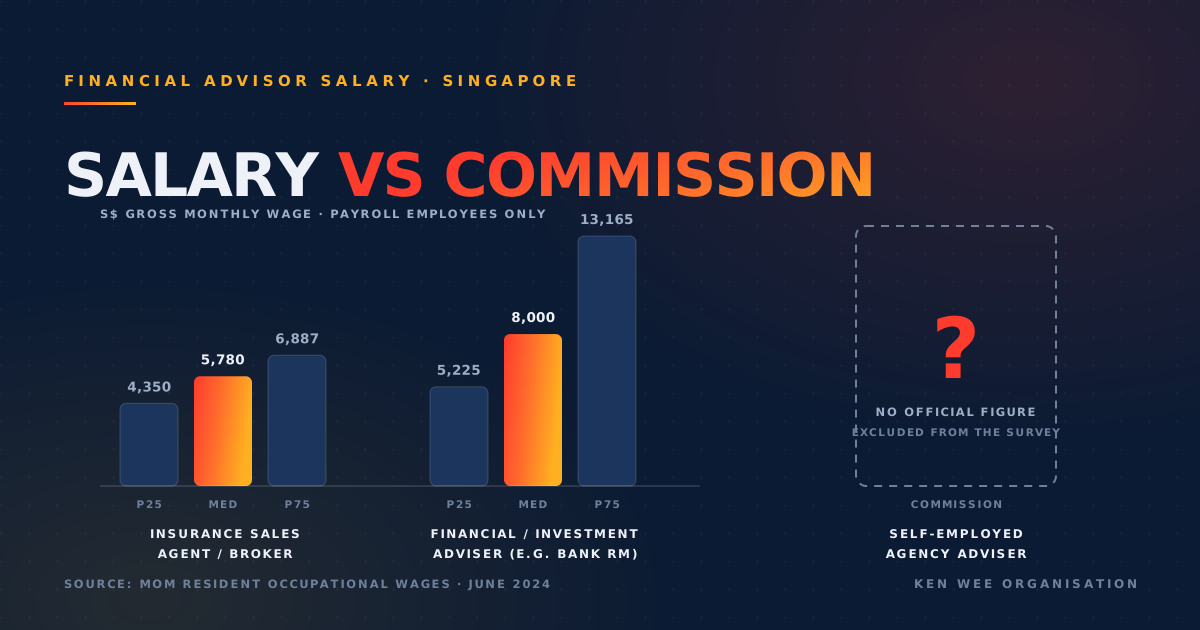
There is no single financial advisor salary in Singapore, because the profession runs on two different employment models. For payroll-employed staff at financial institutions, the Ministry of Manpower's June 2024 Resident Occupational Wages data records a median gross monthly wage of S$5,780 for insurance sales agents/brokers (including independent financial planners) and S$8,000 for financial/investment advisers such as bank relationship managers. But the large share of Singapore's advisory workforce who operate as self-employed appointed representatives under an agency are excluded from that survey by design — they earn commission, not a salary, and no reliable official income figure exists for them. Their income is typically low and volatile in the first two years, and increasingly stable as a client base and renewal commissions accumulate. Here is what each number actually means, and what genuinely determines what you would earn.
The official numbers — and who they actually cover
The only official wage data that touches this profession is MOM's Resident Occupational Wages table. For June 2024 it records:
| Occupation (MOM, June 2024) | 25th percentile | Median gross monthly wage | 75th percentile |
|---|---|---|---|
| Insurance sales agent/broker (including independent financial planner) | S$4,350 | S$5,780 | S$6,887 |
| Financial/investment adviser (e.g. relationship manager) | S$5,225 | S$8,000 | S$13,165 |
The critical limitation sits in MOM's own guidance to the reporting institutions: if advisers or agents are not employed by the company — that is, they operate under an agency — the financial institution should not reflect them in its submission. So these figures cover only direct payroll employees of financial institutions. They are neither a floor nor a ceiling for what a commission-remunerated agency adviser earns; they describe a different population altogether.
Any article quoting you a confident "average financial advisor salary in Singapore" is either citing this payroll-only data, or citing self-reported crowd-sourced figures with unknown methodology. Neither tells you what a self-employed adviser earns.
Why no official figure exists for self-employed advisers
Self-employed appointed representatives — how most tied-agency advisers in Singapore operate — sit outside the official wage survey entirely. For scale: the Life Insurance Association Singapore reported that as of 30 September 2025 the industry employed 9,487 people, while 12,281 representatives held exclusive contracts with companies operating a tied-agency force. That LIA release contains headcount and business volume data only — no income, salary or commission figures.
Industry production benchmarks such as MDRT exist, but their qualification thresholds vary by country and are revised annually — if a figure matters to your decision, take it from mdrt.org or your prospective principal firm directly, not from an article.
How a commission-based adviser is actually paid
A self-employed appointed representative in a tied agency is typically remunerated by commission rather than a fixed salary. Commission is generated when a client implements a recommendation. The components in a life-insurance-led practice are:
- First-year commission — a percentage of the first year's premium on a newly implemented policy. The largest single component in the early years.
- Renewal or servicing commission — a smaller percentage paid in subsequent years while the policy stays in force and you continue servicing the client. This is what turns the job into a business with recurring income.
- Overriding commission — for those who progress into leadership roles and are responsible for a team's production.
- Production bonuses and incentives — firm-specific, typically tied to volume, persistency or quality metrics, and not guaranteed.
Commission percentages vary by product, firm and contract, so no single published figure would be right for most readers. Before joining any firm, ask for the full commission schedule in writing — covering all four components, not just the first-year rate.
The four variables that determine what you earn
- Activity — how many qualified conversations you have. The dominant variable in the early years, and almost entirely within your control.
- Case size — the nature of the clients you serve.
- Persistency — whether the business you write stays on the books. Business sold to someone who did not need it tends to lapse, costing the client money and you your renewal income.
- Time — a practice with clients you have served for years generates income a new practice does not. This is why the first two years are structurally different from year five onwards.
Salaried bank adviser vs commission-based agency adviser
| Bank relationship manager | Agency adviser (self-employed) | |
|---|---|---|
| Remuneration | Fixed salary plus performance bonus — stable, with a ceiling shaped by the bank's structure | Commission — variable, without a fixed ceiling |
| Reference figure | MOM June 2024 median S$8,000 gross monthly (payroll employees) | No official statistic exists |
| CPF | Employer contributions apply | Only MediSave compulsory; Ordinary and Special Account contributions become voluntary |
| Client relationships | Serves clients the bank already has | Builds and owns their own client base |
What changes financially when you go self-employed
Remuneration is only half the salary question. If you join as a self-employed appointed representative, IRAS classifies you as a self-employed person ("commission agent" is one of its named examples), which changes four things at once: your income becomes variable, your CPF Ordinary Account stops filling automatically, you become responsible for your own MediSave contributions (compulsory once net trade income exceeds $6,000), and you handle your own record-keeping and tax filing. On the plus side, you may claim allowable business expenses against commission income, and qualifying commission agents with total annual gross income of $50,000 or less may instead claim a deemed expense of 25% of gross commission income.
The practical implication of the income curve is arithmetic, not motivational: build a financial runway that covers your fixed living costs for a meaningful period before you resign from anything. Some firms offer structured support, allowances or financing for new advisers, particularly career-switchers — ask precisely what is offered, for how long, and on what conditions.
Where the earning ceiling actually sits
Income in this career is not capped by a salary band. At HSBC Life (Singapore) Pte. Ltd., the title ladder runs from Wealth Solutions Consultant — where a new adviser joins and builds their own client practice — through Wealth Solutions Development Manager and Wealth Solutions Manager to Wealth Solutions Director. Progression into the management titles brings responsibility for recruiting and developing a team, with overriding commission on team production becoming a component of remuneration at that stage.
For the full pathway — CMFAS examinations, MAS entry requirements, appointment and CPD — see our complete guide to becoming a financial advisor in Singapore.
Talk it through before you decide
Ken Wee Organisation (KWO) is an agency unit representing HSBC Life (Singapore) Pte. Ltd. (Reg. No. 199903512M), established in February 2020. We recruit and develop Wealth Solutions Consultants, and all our Financial Adviser Representatives are licensed and regulated by the Monetary Authority of Singapore under the Financial Advisers Act. We would rather have an honest conversation that ends in you deciding this career is not for you, than recruit someone who leaves in eight months. If you want a direct, unvarnished view of the numbers as they would apply to your circumstances — including a commission schedule in writing — book a career chat with us.
Frequently asked questions
What is the average financial advisor salary in Singapore?
No reliable average exists for self-employed advisers, because MOM's official wage survey excludes agents who are not payroll employees of a financial institution. For payroll-employed staff, MOM's June 2024 data records a median gross monthly wage of S$5,780 for insurance sales agents/brokers (including independent financial planners) and S$8,000 for financial/investment advisers such as relationship managers. These figures should not be read as what a commission-remunerated agency adviser earns.
How are financial advisors in Singapore paid?
A self-employed appointed representative in a tied agency is typically paid by commission rather than a fixed salary: first-year commission on newly implemented policies, renewal or servicing commission while policies remain in force, overriding commission for those leading teams, and firm-specific production bonuses. Percentages vary by product, firm and contract, so ask your prospective principal for its schedule in writing.
Do financial advisors in Singapore get CPF contributions?
If you are a self-employed appointed representative, only MediSave contributions are compulsory, and only where your net trade income exceeds $6,000. Ordinary Account and Special Account contributions become voluntary. A salaried bank adviser, by contrast, receives employer CPF contributions.
Is a financial advisor's income in Singapore stable?
Commission-based income in this profession is typically low and volatile at the start and increasingly stable as a client base accumulates, because renewal and servicing commissions compound over time. Anyone entering should have savings sufficient to cover fixed living costs for a meaningful period without relying on commission income.
Do financial advisors earn more than bank relationship managers in Singapore?
They are different structures rather than one being higher. A bank relationship manager typically earns a fixed salary plus bonus — MOM's June 2024 median for payroll-employed financial/investment advisers is S$8,000 gross monthly — with a ceiling shaped by the bank. An agency adviser is commission-remunerated with no fixed ceiling but more variability, and no official statistic exists for that population.