
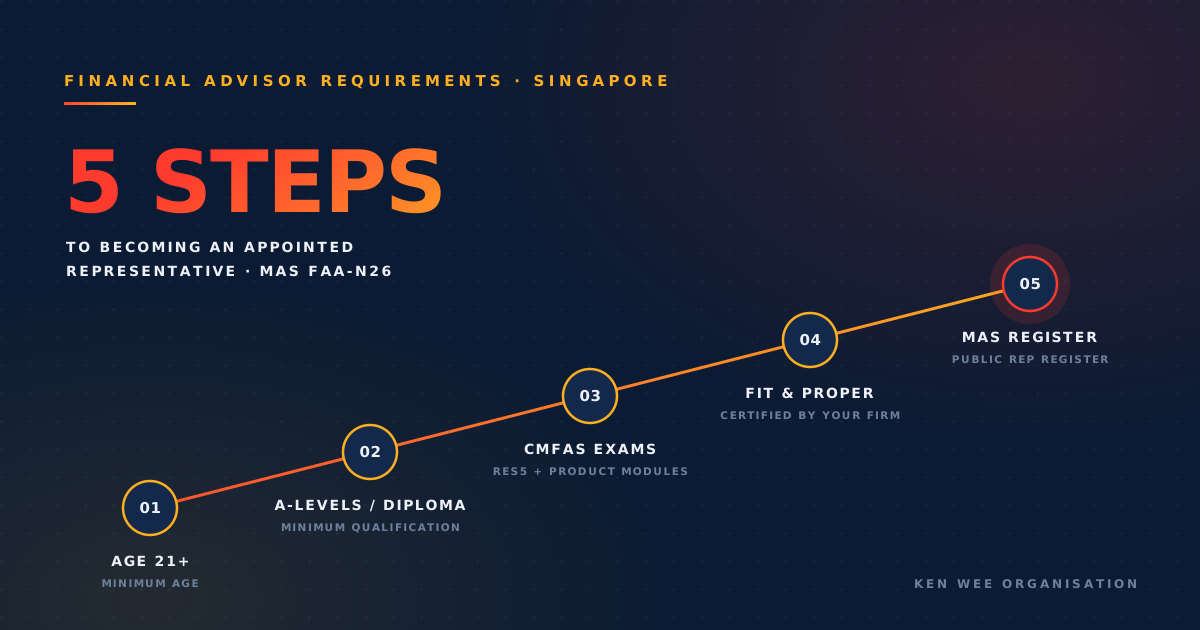
To become a financial advisor in Singapore, you must be appointed as a representative of a licensed or exempt financial adviser under the Financial Advisers Act 2001 — you cannot license yourself. Before a firm can appoint you, MAS Notice FAA-N26 requires you to be at least 21 years old, hold a minimum academic qualification (A-Levels, an International Baccalaureate Diploma, a Singapore polytechnic diploma or an assessed equivalent — a university degree is not required), and pass the relevant CMFAS examinations. For a life-insurance-led career that means RES5 plus M9 and M9A, or the single combined module CM-LIP, plus the HI health insurance module if you will advise on policies with accident and health benefits. Your firm then certifies you as fit and proper, notifies MAS, and your name is entered in the public register of representatives. The whole process commonly takes a few months, not years.
That is the complete legal pathway in one paragraph. The rest of this article breaks it into five concrete steps, with the current post-April-2024 exam details that most older guides get wrong. For the full treatment — remuneration structure, tax and CPF as a self-employed person, and whether the career actually suits you — see our complete guide to becoming a financial advisor in Singapore.
The requirements at a glance
| Requirement | What MAS requires | Where the rule sits |
|---|---|---|
| Minimum age | At least 21 years old — a hard floor with no discretion | MAS Notice FAA-N26, para 3.1 |
| Academic qualification | A-Levels (3 H2 + 2 H1 passes), IB Diploma, Singapore polytechnic diploma, or an assessed equivalent. No degree required. | MAS Notice FAA-N26, para 3.1 |
| Examinations | RES5 + relevant product modules (M9 + M9A or CM-LIP for life policies); HI for accident and health benefits | FAA-N26 para 4.3; MAS Notice 117 |
| Fit and proper | Honesty, integrity and reputation; competence and capability; financial soundness — assessed by your firm, continuing for as long as you practise | MAS Guidelines FSG-G01 |
| Appointment | A principal firm lodges your appointment with MAS and certifies you as fit and proper; you enter the public register | Financial Advisers Act 2001 |
Step 1: Confirm you meet the minimum entry requirements
FAA-N26 sets two personal prerequisites: you must be at least 21, and you must hold one of the minimum academic qualifications — a GCE A-Level certificate with passes in at least three subjects at Higher 2 level and two at Higher 1 level, an IB Diploma, a diploma awarded by a Singapore polytechnic, or a qualification assessed as equivalent.
Two points people consistently get wrong. First, a university degree is not a requirement — the bar is a polytechnic diploma or A-Levels, which is why the profession is genuinely open to career-switchers from outside financial services. Second, "equivalent" is assessed against MAS's published FAQs, not self-declared: if you hold an overseas or non-standard qualification, that assessment is a question for the compliance team of the firm you are joining.
Step 2: Choose your principal firm — before you sit any exam
This is the structural point that confuses most newcomers: firms hold licences; individuals hold appointments. You never receive your own licence. You become an appointed representative of a licensed or exempt financial adviser — your principal — and your authority to advise flows through it.
That is why choosing the firm comes before the exams in practice. Your firm determines exactly which modules you need, usually supports the preparation process, and is the only entity that can appoint you. Sitting exams speculatively also risks the three-year validity rule: a pass in RES5 lapses if you do not commence practice as an appointed representative within three years of passing, and you would have to sit the paper again.
Step 3: Pass the CMFAS examinations
CMFAS — the Capital Markets and Financial Advisory Services Examination — is not one exam but a set of modules. Since the restructure that took effect on 1 April 2024, the structure is always: one rules-and-ethics module everybody takes (RES5), plus product modules matching what you will advise on. If a guide tells you to sit "M5", it is out of date — M5 was renamed and expanded into RES5, and the old paper ceased after 28 March 2024.
For advising on and arranging life policies, the requirement is RES5 plus M9 and M9A — or the combined module CM-LIP in place of both. Both routes are equally valid in the notice. The current formats, per the Singapore College of Insurance:
| Module | Format | Pass mark | Fee (excl. GST) |
|---|---|---|---|
| RES5 — Rules, Ethics and Skills for Financial Advisory Services | 150 MCQs over 3 hours, closed book; run daily on weekdays | 75% in Part I and 80% in Part II | S$150 member / S$180 non-member |
| CM-LIP — Life Insurance and Investment-linked Policies | 150 MCQs over 3 hours, closed book; run weekly | 70% in Part I and 70% in Part II | S$200 member / S$240 non-member |
Note the asymmetry: RES5 has the higher pass marks, and there is no aggregate scoring — you must clear every part. Candidates routinely under-prepare for RES5 on the assumption that the product paper is the hard one; the pass marks say otherwise. There is no limit on resits, but each attempt is a fresh registration and fee (plus a non-refundable S$21.80 registration fee per attempt — confirm current fees on SCI's portal before budgeting). If you will advise on life policies with accident and health benefits — which covers most protection work in practice — you also need the HI health insurance module under MAS Notice 117, listed at S$76.30.
Step 4: Get appointed and check the register
Passing the exams changes nothing by itself. Your principal firm notifies MAS of its intention to appoint you, lodging the appointment and certifying you as fit and proper through MAS's CoRe system. The fit-and-proper standard covers honesty, integrity and reputation; competence and capability; and financial soundness — and it is a continuing condition of practice, not a one-time test.
Once appointed, your name appears in the Financial Institution Representatives Register, publicly searchable at eservices.mas.gov.sg/rr. Use it in both directions: clients can verify you, and you should look up any firm's representatives before you commit to joining it.
Step 5: Keep up your CPD every year
Appointment starts an ongoing obligation. For a typical advisor advising on and arranging life policies, FAA-N26 requires 6 Core CPD hours plus 24 Supplementary hours — 30 hours per calendar year, with an exemption for the first calendar year in which you are first appointed and pro-rating for partial years. CPF Board courses count towards Core hours, which is genuinely useful given how central CPF is to planning in Singapore.
How long does the whole process take?
There is no fixed statutory period. The timeline is driven by exam preparation and scheduling plus your principal's appointment process, and is commonly a matter of a few months from decision to first client conversation. RES5 runs daily on weekdays; CM-LIP runs weekly, so plan around it. It is one of the shorter regulated-profession entry paths in Singapore.
What this looks like in practice
Ken Wee Organisation (KWO) is an agency unit representing HSBC Life (Singapore) Pte. Ltd., established in February 2020, and we recruit and develop Wealth Solutions Consultants — the entry title on HSBC Life's ladder, which runs Wealth Solutions Consultant, Wealth Solutions Development Manager, Wealth Solutions Manager, and Wealth Solutions Director. All our Financial Adviser Representatives are licensed to advise on investment products and arrange life policies, and the pathway they each followed is exactly the five steps above. No finance background is needed to start.
If you are weighing this career seriously, the remaining question is fit, not process — and that is best settled in conversation with people doing the work. Book a career chat with our team, led by founder Phua Ken Wee and development manager Rowena Wong. We would rather have an honest conversation that ends in you deciding this is not for you than recruit someone who leaves in eight months.
Frequently asked questions
What are the requirements to become a financial advisor in Singapore?
Under MAS Notice FAA-N26 you must be at least 21 years old, hold a minimum academic qualification (A-Levels with 3 H2 and 2 H1 passes, an IB Diploma, a Singapore polytechnic diploma, or an assessed equivalent), and pass the relevant CMFAS examination modules. You must then be appointed as a representative by a licensed or exempt financial adviser, which certifies you as fit and proper and notifies MAS.
Do I need a university degree to become a financial advisor in Singapore?
No. A degree is not required by MAS Notice FAA-N26. The minimum academic qualification is A-Levels, an IB Diploma, a Singapore polytechnic diploma, or an assessed equivalent — which is why the profession is open to career-switchers from outside financial services.
Which CMFAS exams do I need to advise on life insurance in Singapore?
A valid pass in RES5 (Rules, Ethics and Skills for Financial Advisory Services), plus M9 and M9A — or the single combined module CM-LIP in place of both. If you will advise on or arrange life policies with accident and health benefits, you also need the HI health insurance module under MAS Notice 117. Note that M5 no longer exists: it was renamed and expanded into RES5 from 1 April 2024.
How long does it take to become a financial advisor in Singapore?
There is no fixed statutory period. In practice the timeline is driven by exam preparation and scheduling plus the principal firm's appointment process, and is commonly a matter of a few months rather than years. RES5 is conducted daily on weekdays and CM-LIP weekly.
How much do the CMFAS exams cost?
Per the Singapore College of Insurance's published schedule: RES5 is S$150 for members and S$180 for non-members excluding GST; CM-LIP is S$200 and S$240 respectively. A non-refundable registration fee of S$21.80 including GST applies to each attempt, and the HI module is listed at S$76.30. There is no limit on resits, but each attempt attracts a fresh fee. Confirm current fees with SCI before budgeting.