
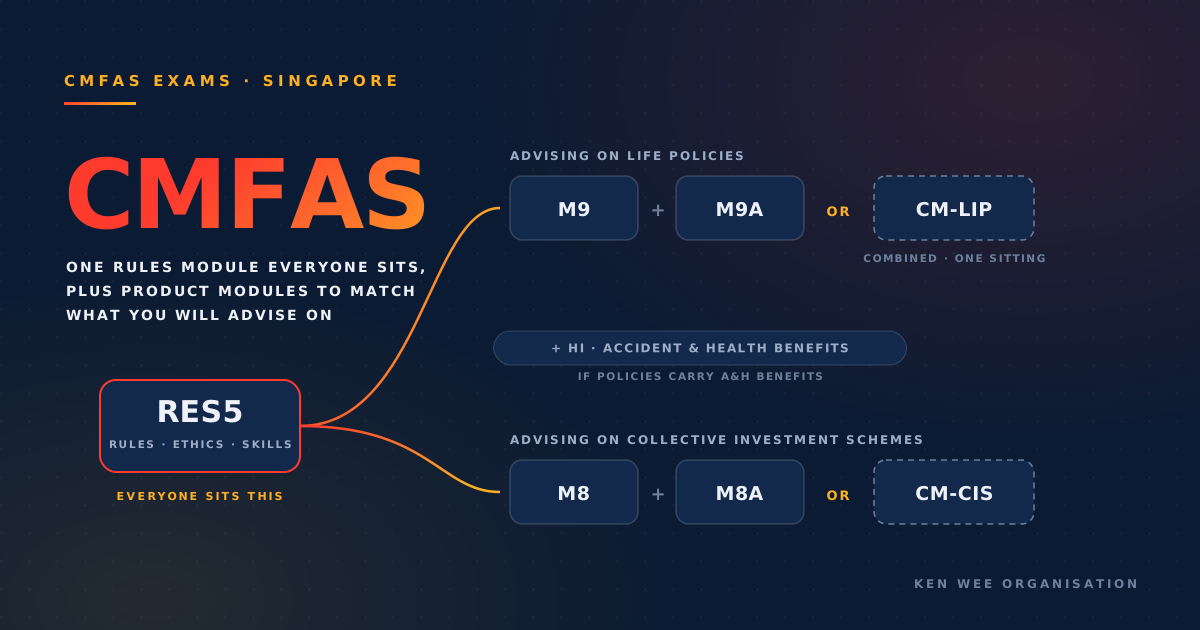
The CMFAS exam — the Capital Markets and Financial Advisory Services Examination — is the set of examination modules the Monetary Authority of Singapore (MAS) requires you to pass before a firm can appoint you as a representative of a financial adviser under the Financial Advisers Act 2001. Since the restructure that took effect on 1 April 2024, every prospective adviser sits RES5 (Rules, Ethics and Skills for Financial Advisory Services), plus product knowledge modules matched to what they will advise on. For a life-insurance-led career that means RES5 + M9 + M9A, or RES5 plus the combined module CM-LIP in place of both. If you will advise on or arrange life policies with accident and health benefits, you also need the HI health insurance module. The exams are administered by the Singapore College of Insurance (SCI) or the Institute of Banking and Finance (IBF), are closed book and computer-based, and there is no limit on retakes.
M5 no longer exists — the 2024 restructure
A large share of the advice still circulating online describes the old regime, so start here. On 28 September 2023 MAS issued Notice FAA-N26, and the CMFAS examinations were restructured to match it from 1 April 2024. The old rules module M5 was renamed RES5 and substantially expanded — from "Rules and Regulations" at 100 questions over 120 minutes to "Rules, Ethics and Skills" at 150 questions over 3 hours. SCI ceased offering the old M5 after 28 March 2024. If a guide, forum thread or tuition provider still tells you to "sit M5", it is describing a paper that no longer exists.
Which CMFAS modules do you need?
The structure is always one rules-and-ethics module that everybody takes, plus product modules that depend on the advice you will give. FAA-N26's Table 1 maps activity to modules; simplified for the common paths:
| What you intend to do | Rules module | Product modules (single) | Combined option |
|---|---|---|---|
| Advising on or arranging life policies | RES5 | M9 + M9A | CM-LIP |
| Advising on units in a collective investment scheme | RES5 | M8 + M8A (or CM-EIP / CM-SIP) | CM-CIS |
| Both life policies and collective investment schemes | RES5 | M8 + M8A + M9 + M9A | CM-LIC |
The combined modules trade convenience for risk: CM-LIP replaces M9 and M9A with one registration, one exam day and one fee — but it is a longer paper covering the full scope in a single sitting, with no chance to bank a partial pass. Sitting M9 and M9A separately gives you two shorter papers and two chances to consolidate, at the cost of two registrations and two fees. There is no regulatory preference either way.
Format and pass marks — where people get caught out
| RES5 | CM-LIP | |
|---|---|---|
| Questions | 150 MCQ (110 Part I, 40 Part II) | 150 MCQ (100 Part I, 50 Part II) |
| Duration | 3 hours | 3 hours |
| Pass mark | 75% Part I and 80% Part II | 70% Part I and 70% Part II |
| Delivery | Closed book, computer screen examination | Closed book, computer screen examination |
| Frequency | Daily on weekdays | Once a week |
Note the asymmetry: RES5 has the higher pass marks, not the product paper. Candidates routinely assume the product knowledge module is the hard one and under-prepare for the rules-and-ethics paper. There is also no aggregate scoring — you must clear every part on its own. Scoring 95% on Part I of RES5 does not rescue a 78% on Part II, because Part II requires 80%; you would re-sit. The single product modules M8, M8A, M9 and M9A each carry a 70% pass mark.
There is no cap on attempts. SCI states plainly that there is no limit to the number of times a candidate can sit an examination, and no waiting period between attempts is stated — each attempt simply requires a fresh registration and fee.
What the exams cost
Per SCI's published schedule at the 1 April 2024 changeover: RES5 is S$150 for SCI members and S$180 for non-members (excluding GST; S$163.50 and S$196.20 with 9% GST). CM-LIP and CM-CIS are S$200 / S$240, and CM-LIC is S$400 / S$480. A non-refundable registration fee of S$21.80 (inclusive of GST) is added per attempt, and the HI module is listed at S$76.30. SCI has noted that CMFAS fees had not been revised since the examinations launched in 2002 — a recent change is unlikely, but confirm the current figure on SCI's site before registering. In practice, many principal firms support or subsidise the exam process for incoming advisers.
The HI module most people forget
If you intend to advise on or arrange life policies that carry accident and health benefits — which in practice covers a very large proportion of the protection work an adviser does — RES5 and the life modules are not sufficient on their own. Under MAS Notice 117, you must also pass the HI health insurance module. HI was not renamed or absorbed in the 2024 restructure. The practical consequence: most new advisers entering an insurance-led practice sit RES5, the life modules (M9 + M9A or CM-LIP) and HI — three or four papers in total, not two.
Your passes can expire: the three-year rule
This is the most commonly missed provision in FAA-N26. A pass in RES5 ceases to be valid if you do not commence providing financial advisory services as an appointed representative within three years of passing, or if you cease practising and do not recommence within three continuous years. Either way, you sit the paper again. So do not sit the exams speculatively, years ahead of an actual move — sit them when you have a principal firm in view and a realistic start date.
A sensible order of operations
- Confirm you meet the entry requirements — at least 21 years old, holding A-Levels (passes in three H2 and two H1 subjects), an IB Diploma, a Singapore polytechnic diploma, or an assessed equivalent. A university degree is not required.
- Identify your principal firm first, not after the exams. Your firm determines which modules you actually need, usually supports the process, and is the only party that can appoint you — you cannot appoint yourself. Choosing a firm before you register also protects you from the three-year validity clock.
- Sit RES5, then your product modules, then HI if your practice will touch accident and health benefits. Give RES5 more preparation than instinct suggests — it carries the higher pass marks. The papers are closed book and SCI supplies the study text; there is no shortcut around reading it.
- Your firm lodges the appointment with MAS, and your name is entered in the public Financial Institution Representatives Register. From decision to first client conversation is commonly a few months, dominated by exam preparation and scheduling.
For the full pathway — the regulatory framework, fit-and-proper criteria, CPD obligations and how appointment actually works — see our complete guide on how to become a financial advisor in Singapore.
Frequently asked questions
Is M5 still the CMFAS rules exam?
No. M5 was renamed and expanded into RES5 (Rules, Ethics and Skills for Financial Advisory Services) under FAA-N26. SCI ceased offering M5 after 28 March 2024.
Which modules do I need for life insurance?
A valid pass in RES5, plus M9 and M9A — or the combined CM-LIP in place of both. Add HI if you will advise on or arrange policies with accident and health benefits.
How hard is RES5?
It carries the strictest pass marks in the set: at least 75% for Part I and 80% for Part II, with no aggregate scoring across parts. Budget more preparation for it than for the product modules.
Can I fail and retake?
Yes, without limit. Each attempt requires a fresh registration and fee.
Thinking about the career itself?
Ken Wee Organisation is an agency unit representing HSBC Life (Singapore) Pte. Ltd. (Reg. No. 199903512M), established in February 2020. We recruit and develop Wealth Solutions Consultants, and our Financial Adviser Representatives are licensed to provide financial planning services including advising on investment products and arranging life policies. If you want a direct, unvarnished conversation about whether this career fits your circumstances — including which modules you would actually need and in what order — book a career chat with Phua Ken Wee, our Founder and Wealth Solutions Director, or Rowena Wong, our Wealth Solutions Development Manager. No finance background needed.
Frequently asked questions
What is the CMFAS exam in Singapore?
CMFAS stands for the Capital Markets and Financial Advisory Services Examination. It is the set of examination modules MAS requires prospective representatives to pass before they can be appointed to provide financial advisory services under the Financial Advisers Act 2001. The modules are administered by the Singapore College of Insurance (SCI) or the Institute of Banking and Finance (IBF), and are closed-book, computer-based examinations.
Which CMFAS modules do I need to advise on life insurance in Singapore?
A valid pass in RES5 (Rules, Ethics and Skills for Financial Advisory Services), plus the product knowledge modules M9 and M9A — or the single combined module CM-LIP in place of both. If you will advise on or arrange life policies with accident and health benefits, you also need the HI health insurance module under MAS Notice 117.
Is M5 still the CMFAS rules exam?
No. Under MAS Notice FAA-N26, M5 was renamed and expanded into RES5 — Rules, Ethics and Skills for Financial Advisory Services. SCI ceased offering the old M5 after 28 March 2024, and the new examinations took effect from 1 April 2024.
What are the pass marks for RES5 and CM-LIP?
RES5 requires at least 75% for Part I and at least 80% for Part II. CM-LIP requires at least 70% for each of its two parts. There is no aggregate scoring — every part must be passed on its own. Both papers are 150 multiple-choice questions over 3 hours.
Do CMFAS passes expire?
Yes. A pass in RES5 ceases to be valid if you do not commence providing financial advisory services as an appointed representative within three years of passing, or if you cease practising and do not recommence within three continuous years. In either case you must re-take and pass RES5.