
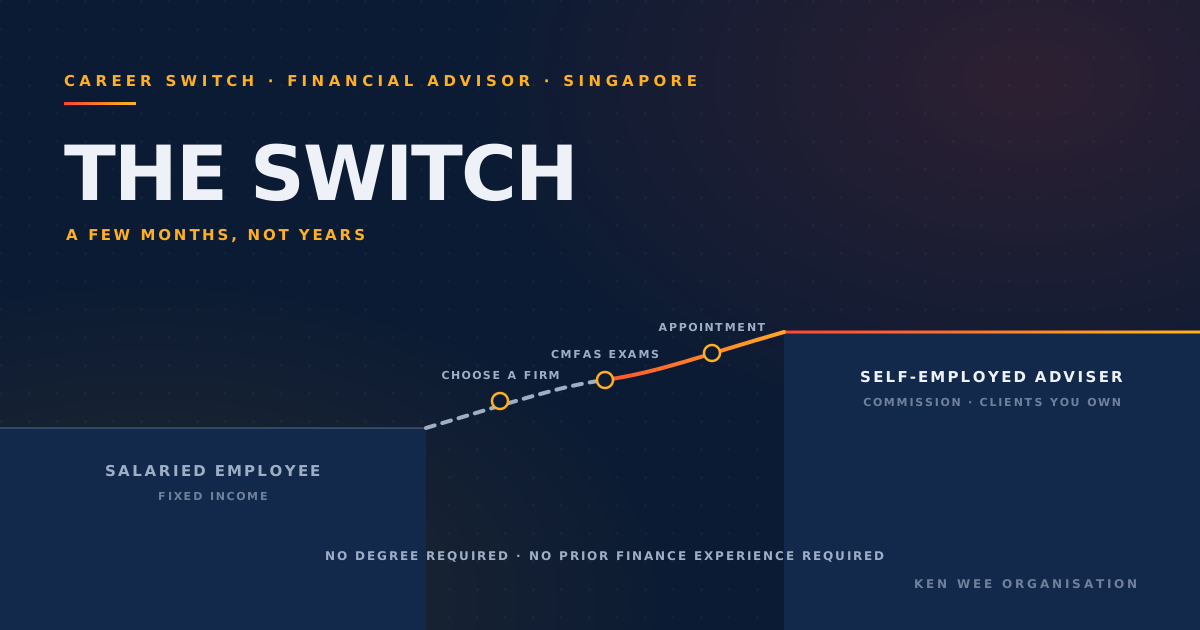
Yes — you can switch careers to become a financial advisor in Singapore from almost any background, and the change typically takes a few months rather than years. You do not need a university degree and you do not need prior finance experience. Under MAS Notice FAA-N26, you must be at least 21, hold a minimum academic qualification (A-Levels, an IB Diploma, a Singapore polytechnic diploma, or an assessed equivalent), pass the relevant CMFAS examinations — RES5 plus M9 and M9A, or the combined CM-LIP module, plus the HI module if you will advise on policies with health benefits — and be appointed as a representative by a licensed or exempt financial adviser firm, which certifies you as fit and proper to MAS. The exams are the visible hurdle; the real switch is the move from a salaried job to self-employed, commission-based income. This guide covers both honestly.
Can you switch with no finance background?
Regulatorily, yes. The minimum academic bar set by MAS Notice FAA-N26 is a GCE 'A' Level certificate (passes in at least three H2 and two H1 subjects), an International Baccalaureate Diploma, a diploma from a Singapore polytechnic, or an academic qualification assessed as equivalent. A degree is not required, and no prior financial services experience is required. This is one of the shorter regulated-profession entry paths in Singapore, which is precisely why it attracts mid-career switchers from teaching, engineering, hospitality, the uniformed services and corporate roles.
In practice, career-switchers often do well in the examinations. The CMFAS papers are closed-book and largely definitional — they reward systematic study of the official text rather than industry intuition. People with financial services backgrounds sometimes answer from how things worked at their old firm rather than from what the syllabus says; a newcomer studying from scratch has no such habit to unlearn.
The five steps of the switch, in order
- 1. Confirm you meet the entry requirements. At least 21 years old, with A-Levels, an IB Diploma, a polytechnic diploma, or an assessed equivalent. If your qualification is overseas or non-standard, equivalence is assessed by the firm's compliance team against MAS guidance — not self-declared.
- 2. Choose your principal firm before you sit any exam. You cannot appoint yourself; a firm must appoint you, and your firm determines exactly which modules you need and usually supports the process. Sitting exams speculatively also risks the validity clock: a pass in RES5 lapses if you do not commence practice as an appointed representative within three years.
- 3. Pass the CMFAS examinations. For a life-insurance-led advisory career: RES5 (Rules, Ethics and Skills for Financial Advisory Services) plus M9 and M9A — or the single combined module CM-LIP in place of both. Add the HI health insurance module if you will advise on or arrange life policies with accident and health benefits, which covers most protection work.
- 4. Get appointed. Your principal firm assesses you as fit and proper — honesty, integrity and reputation; competence and capability; and financial soundness — and lodges the notification with MAS. Your name is then entered in the public Financial Institution Representatives Register, which anyone can search.
- 5. Start your practice. The career is decided by activity in the first months, not by further study. Your first calendar year of appointment is exempt from the CPD requirement; from the following year, a typical adviser advising on and arranging life policies completes 30 hours of continuing professional development per calendar year (6 Core + 24 Supplementary).
What actually changes when you leave a salaried job
The examinations are a study project. The structural change is bigger, and it is the part career-switchers most often underestimate. Most agency advisers operate as self-employed appointed representatives, and that changes four things at once:
| Salaried employee | Self-employed adviser | |
|---|---|---|
| Income | Fixed salary, predictable | Commission-based — typically low and volatile at the start, increasingly stable as a client base accumulates |
| CPF | Employer and employee contributions to OA, SA and MediSave | Only MediSave contributions are compulsory (above $6,000 net trade income); Ordinary Account and Special Account contributions become voluntary |
| Tax | Employment income | Taxed as a self-employed person; allowable business expenses deductible, with a simplified 25% deemed-expense option for qualifying commission agents earning under $50,000 |
| Benefits | Paid leave, medical benefits | Generally none provided — you arrange your own protection |
The CPF change deserves particular attention if you are servicing a mortgage with Ordinary Account contributions: as a self-employed adviser, nothing accumulates in your OA unless you deliberately make voluntary contributions. Plan for that before you resign, not after.
The practical implication of the income change is arithmetic, not motivational: build a financial runway that covers your fixed living costs for a meaningful period before you hand in your notice. Some firms offer structured support or allowances for new advisers, particularly career-switchers — ask precisely what is offered, for how long, and on what conditions.
What the switch costs and how long it takes
The direct costs are modest. Per the Singapore College of Insurance's published schedule, RES5 is S$150 (members) or S$180 (non-members) excluding GST per attempt, and CM-LIP is S$200 or S$240, with a non-refundable S$21.80 registration fee per attempt; the HI module is listed at S$76.30. There is no limit on resits, though each attempt is a fresh fee. Confirm current fees with SCI before budgeting.
On timing: RES5 runs daily on weekdays and CM-LIP weekly, so scheduling is flexible. The elapsed time from decision to first client conversation is commonly a matter of months, dominated by exam preparation and your principal firm's appointment process. One trap to avoid: RES5 has the higher pass marks (75% for Part I and 80% for Part II, versus 70% and 70% for CM-LIP), so give the rules-and-ethics paper more preparation than instinct suggests. Both papers are 150 multiple-choice questions over three hours, and you must pass every part — there is no aggregate score.
For the full module tables, fees, validity rules and the appointment process in detail, see our complete guide: How to Become a Financial Advisor in Singapore.
Who should not switch yet
An honest filter, because the profession's barriers to entry are low but its barriers to success are high. Hold off if any of these applies: you cannot cover your fixed costs on a variable income for a sustained period; you have no genuine interest in the technical content (CPF, tax treatment, insurance structures — that material is the job, not the paperwork around it); or repeated rejection is something that stops you rather than something you metabolise. None of these makes the career wrong for you forever — but each makes it wrong for you right now, and the correct move is to fix the constraint first.
Talking to an agency before you decide
The decision that remains after research is a fit question, and it is best answered in conversation with people doing the work. Ken Wee Organisation (KWO), established in February 2020, is an agency unit representing HSBC Life (Singapore) Pte. Ltd. (Reg. No. 199903512M). Its Financial Adviser Representatives are licensed and regulated by MAS under the Financial Advisers Act, and it recruits and develops Wealth Solutions Consultants — the entry title on the HSBC Life ladder, which runs from Wealth Solutions Consultant through Development Manager and Manager to Director. The team is led by Phua Ken Wee, Founder and Wealth Solutions Director, and Rowena Wong, Wealth Solutions Development Manager — no finance background is needed to join.
KWO's stated position on recruitment is worth quoting because it is the right standard to hold any agency to: it would rather have an honest conversation that ends in you deciding the career is not for you than recruit someone who leaves in eight months. If you are weighing the switch, book a career chat and ask the hard questions — runway, commission schedule in writing, support conditions — before you resign from anything.
Frequently asked questions
Can I switch to being a financial advisor in Singapore without a degree?
Yes. MAS Notice FAA-N26 does not require a university degree. The minimum academic qualification is a GCE 'A' Level certificate (three H2 and two H1 passes), an International Baccalaureate Diploma, a Singapore polytechnic diploma, or an assessed equivalent, together with a minimum age of 21. No prior finance experience is required.
How long does a career switch to financial advisor take in Singapore?
Commonly a matter of months rather than years. The timeline is dominated by CMFAS exam preparation and your principal firm's appointment process. RES5 is conducted daily on weekdays and CM-LIP weekly, so scheduling is flexible.
Which exams do I need to become a financial advisor in Singapore?
For a life-insurance-led advisory career: a valid pass in RES5 (Rules, Ethics and Skills for Financial Advisory Services), plus the product knowledge modules M9 and M9A — or the single combined module CM-LIP in place of both. If you will advise on or arrange life policies with accident and health benefits, you also need the HI health insurance module under MAS Notice 117.
What happens to my CPF if I switch to a self-employed financial advisor role?
Only MediSave contributions are compulsory, and only where your net trade income exceeds $6,000. Ordinary Account and Special Account contributions become voluntary — nothing accumulates in your OA unless you deliberately contribute, which matters if you are servicing a mortgage with OA funds.
Do I need to resign from my current job before taking the CMFAS exams?
No. Most career-switchers prepare and sit the examinations while still employed. But do not sit them speculatively years ahead of a real move: a pass in RES5 ceases to be valid if you do not commence practice as an appointed representative within three years of passing. Choose your principal firm first, then sit the exams with a realistic start date in view.